The Dangers of Protocol Conformances in Swift
A recent release of Swift Log (v1.8.0), which includes a PR I authored, has caused a ripple effect of unexpected breaking changes across the Swift Package ecosystem. This post explores what happened, why it happened, and how we can avoid similar issues in the future.
The Pull Request
In Swift server-side applications, logging is handled by Swift Log, a logging API and implementation library maintained by Apple, widely used across the ecosystem.
As part of my contributions to Vapor 5, I moved some logging-related functionality from Vapor to ConsoleKit v5 and Swift Configuration.
One of the few things left in Vapor in that regard was a simple extension to make Logger.Level (a type from Swift Log) @retroactively conform to CustomStringConvertible and LosslessStringConvertible, two standard library protocols.
@retroactive is a Swift attribute that warns you when you conform types you don’t own to protocols you don’t own.
It exists to make you aware of the risks you’re taking: if the type later adopts the same protocol, you end up in non-deterministic behavior, as the compiler won’t know which conformance to use.
You can read more about @retroactive in SE-0364.
Going back to the @retroactive conformances in Vapor, since these were conformances to standard library protocols that I knew were fairly widely replicated across the ecosystem and that would be generally useful, I decided to propose moving them directly into Swift Log instead.
So, I opened apple/swift-log#395, motivating the reasons behind this change.
Contents of the PR (minus tests):
extension Logger.Level: CustomStringConvertible, LosslessStringConvertible {
    /// A textual representation of the log level.
    public var description: String {
        self.rawValue
    }

    /// Creates a log level from its textual representation.
    /// - Parameter description: A textual representation of the log level, case insensitive.
    public init?(_ description: String) {
        self.init(rawValue: description.lowercased())
    }
}
The PR was reviewed, accepted and merged, and Swift Log v1.8.0 was released shortly after. It was rightly released as a minor version bump, as conformances to standard library protocols and new APIs, such as computed variables and initializers, are not considered breaking changes by SemVer 2.0.
Unexpected Consequences
Shortly after the release, discussions started about how SwiftPM would handle the @retroactive conformances in libraries.
@fpseverino on Discord:
It’s gonna look great on my resume: “Destroyed the whole Swift package ecosystem”
Soon enough, conflicts started to appear: the first library to fall victim was Vapor itself.
@retroactive Conformances
When trying to use logLevel.description or the LosslessStringConvertible initializer, users of Vapor would get a compiler error about ambiguous use of those members.
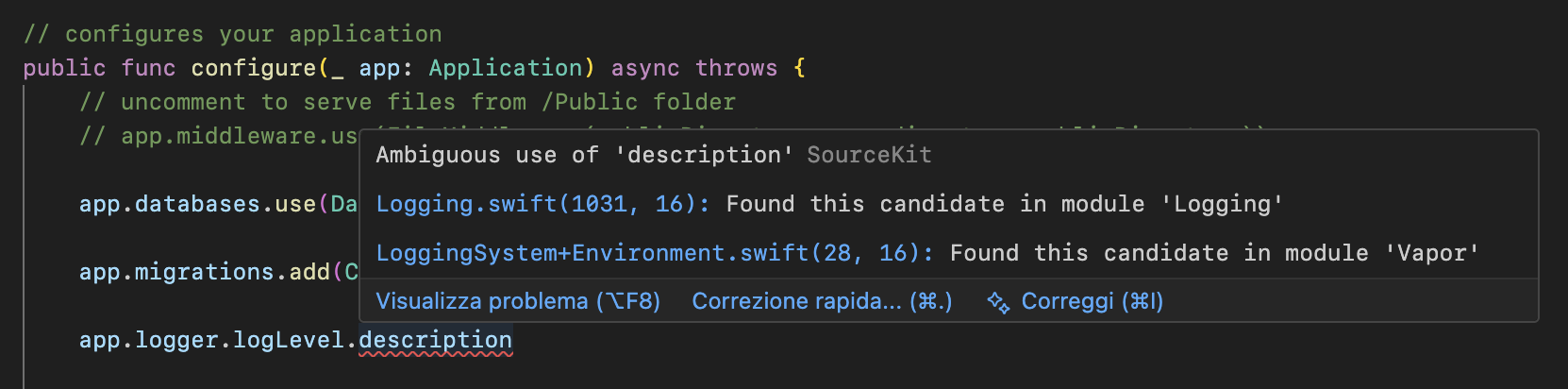
The issue was that both Vapor and Swift Log were providing conformances to those protocols for Logger.Level.
As previously mentioned, the conformances in Vapor were marked as @retroactive, which means that you, the author of said conformance, acknowledge that if the type being conformed to (which you don’t own) later provides the same conformance you end up in non-deterministic behavior.
And that is exactly what happened here: Swift Log added the same conformances, and now the compiler couldn’t decide which one to use.
The issue was quickly fixed by removing the conformances from Vapor, and a new release (v4.120.0) was cut.
Combining Multiple Protocol Conformances
Next, a different issue appeared in the Hummingbird template.
The template uses Swift Argument Parser to get the log level from command line arguments, so it had an empty extension that @retroactively made Logger.Level conform to ExpressibleByArgument.
extension Logger.Level: @retroactive ExpressibleByArgument {}
That worked because Swift Argument Parser has two extensions to RawRepresentable and LosslessStringConvertible that provide a default initializer for ExpressibleByArgument for types conforming to one of those protocols.
extension RawRepresentable where Self: ExpressibleByArgument, RawValue: ExpressibleByArgument {
    public init?(argument: String) {
        if let value = RawValue(argument: argument) {
            self.init(rawValue: value)
        } else {
            return nil
        }
    }
}

extension LosslessStringConvertible where Self: ExpressibleByArgument {
    public init?(argument: String) {
        self.init(argument)
    }
}
Before Swift Log v1.8.0, Logger.Level only conformed to RawRepresentable, so there was no ambiguity.
After the release, however, Logger.Level conformed to both RawRepresentable and LosslessStringConvertible, so the compiler couldn’t decide which initializer to use.
So the issue really lied in Swift Argument Parser, which didn’t account for the possibility of a type conforming to both protocols.
The Hummingbird template has to use a @retroactive conformance in this case, as Swift Argument Parser and Swift Log are (presumably) never going to depend on each other.
The Hummingbird template was quickly fixed too, by providing a custom implementation to ExpressibleByArgument instead.
The ambiguity issue was fixed in Swift Argument Parser as well, in apple/swift-argument-parser#841, by adding a more specific extension for types conforming to both protocols.
Capturing Function Signatures without Spelling Out the Parameter Labels
The last library (so far) to be affected was the Swift AWS Lambda Runtime, and the issue was completely different from the previous two.
The library didn’t provide any @retroactive conformance, neither did it expect Logger.Level to conform to any protocol, like in the Hummingbird/ArgumentParser case.
Instead, the issue was that Swift AWS Lambda Runtime used the Logger.Level initializer provided by RawRepresentable inside a mapping function, passing directly the initializer signature to flatMap, without spelling out the parameter label, like so:
log.logLevel = Lambda.env("LOG_LEVEL").flatMap(Logger.Level.init) ?? logger.logLevel
The compiler was able to resolve the call to Logger.Level.init before Swift Log v1.8.0, because there was only one initializer available that took a String: the one provided by RawRepresentable.
After the release, however, there was now a second initializer available, the one provided by LosslessStringConvertible, that also takes a String, so the compiler couldn’t decide which one to use.
The issue has been fixed in awslabs/swift-aws-lambda-runtime#619 by calling flatMap with a closure that explicitly calls the desired initializer, like so:
log.logLevel = Lambda.env("LOG_LEVEL").flatMap { .init(rawValue: $0) } ?? logger.logLevel
Another possible fix would have been to spell out the parameter label when passing the initializer to flatMap, like so:
log.logLevel = Lambda.env("LOG_LEVEL").flatMap(Logger.Level.init(rawValue:)) ?? logger.logLevel
What We Learned
There are a few lessons that I think we can learn from this incident:
-
We shouldn’t extend types we don’t own with
@retroactiveconformances to protocols we don’t own, especiallypublicly. This applies in particular to standard library protocols, which are more likely to be adopted by types in the future.@retroactiveand its warning exist exactly for this reason, to make you aware of the risks you’re taking. -
While very similar,
RawRepresentable,CustomStringConvertibleandLosslessStringConvertibleserve different purposes, and it’s not unlikely that a type would want to conform to more than one of them. Libraries that provide default implementations based on those protocols (like Swift Argument Parser) should take this into account, and avoid ambiguities. -
We should put extra thought when working with remote library packages, both as users and as contributors/maintainers. As users, we should be aware that we don’t own the code, and even if it follows SemVer 2.0 it might change in unexpected ways, as we’ve seen. As contributors and maintainers, we should be aware that even additive changes, especially to widely used libraries like Swift Log, can have far-reaching and unpredictable consequences (see also Hyrum’s Law).
-
And last but not least, the Swift open source community once again proved to be amazing, quickly identifying and fixing the issues caused by this change. Thanks to everyone involved in the discussions and fixes!